BWFNet: 3D Building Reconstruction from Single Off-Nadir Remote Sensing Image with Semi-Weak Supervisions
Paper Code
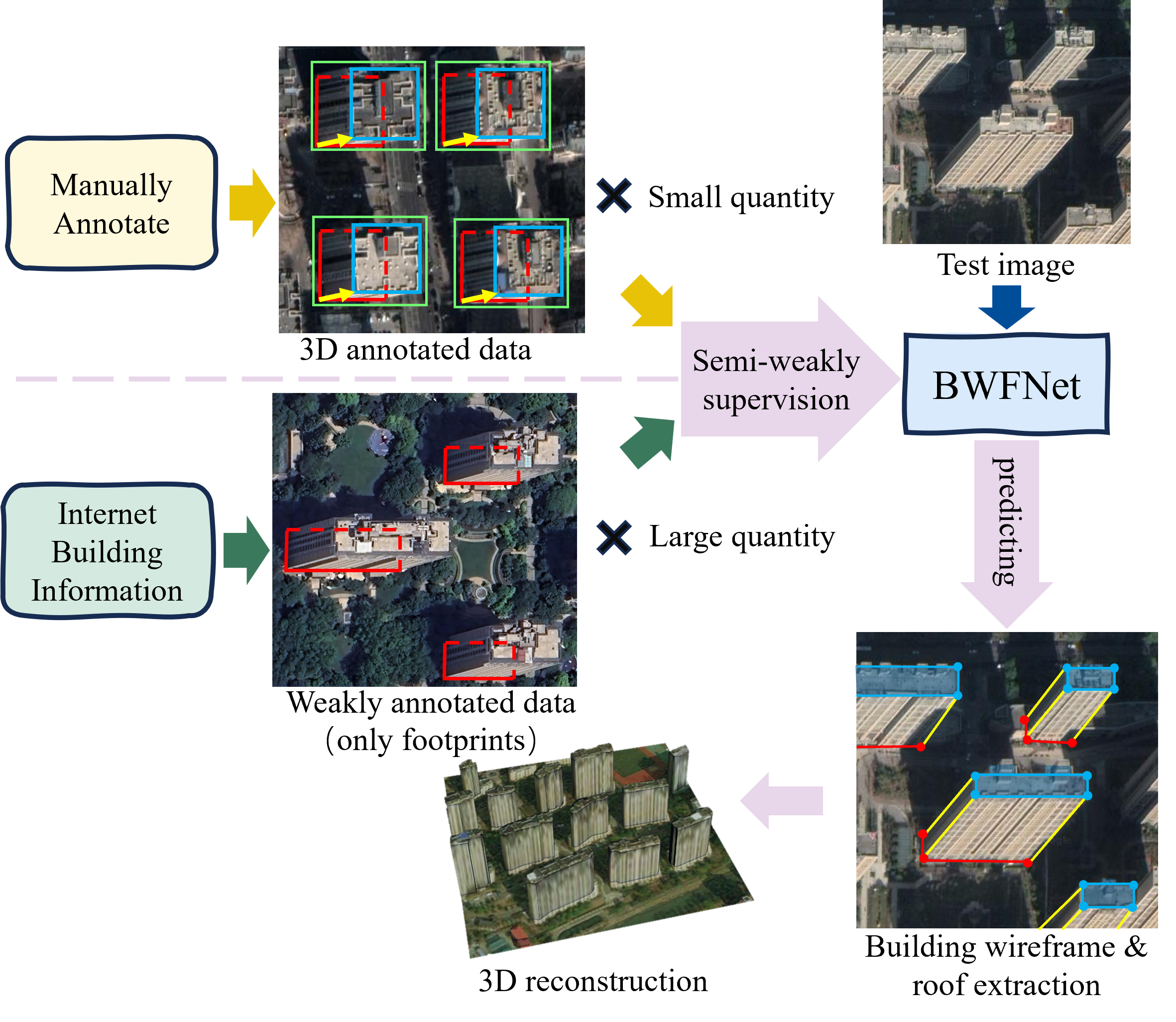
Rapid 3D building reconstruction in urban-scale areas has emerged as a pivotal technology for
smart city applications. Recent methods that reconstruct buildings from single off-nadir imagery
have gained attention due to their efficiency in both time and data costs. However, the training
of these methods relies on large-scale, costly 3D annotations, including building bounding
boxes, roofs, footprints, and roof-to-footprint offsets, and thus cannot be trained when only
the footprint is available, despite the fact that a large amount of building footprints can be
easily obtained in crowdsourced building data set form the Internet. To address this, we propose
a semi-weakly supervised learning method that leverages massive weakly annotated data
(footprints) and a limited number of manually annotated 3D building labels to learn to
reconstruct 3D buildings. In our method, we introduce an ingenious wireframe representation to
replace conventional bounding-box representation, thereby providing a foundation for semi-weakly
supervised learning. Based on this representation, we propose BWFNet for extracting building
wireframes. BWFNet enhances accuracy under semi-weakly supervision by modeling both structural
and local knowledge. Furthermore, we propose a training strategy for building wireframe
extraction grounded in the principle of geometric consistency constraints to further improve
weakly supervised performance. The experimental results demonstrate that the proposed BWFNet
achieves excellent reconstruction performance by utilizing only 3% fully annotated data combined
with weakly supervised samples. This performance represents a significant improvement compared
to current state-of-the-art methods.